





Recent Posts
- Tomorrow is lowkey Reveal Day
- .bank registry looking for new boss
- Junk drop hits .my domains hard
- As GoDaddy loses .us to Identity Digital, some domains may be at risk
- “Time to lawyer up…” Anger grows over Verisign’s .name bloodbath
- stupid.domain.name owner fights Verisign turn-off
- Unliked — Chinese gTLD calls it quits
- .phone domain gets launch dates
- Domainer AI slop crackdown on the cards in Oz
- Team Internet still expects over $160 million for domains business
- Newfold settles Meta cybersquatting lawsuit
- DropCatch acquires 300 more registrars
- Helsinki throws in the towel on city gTLD
- “Bulletproof” registrar takes a bullet to the head
- .net prices going up
- Robles to join ICANN board
- Former ICANN director Bertrand de La Chapelle dies
- Fifty-six orgs get 85% off their gTLD fees
- Texas will object to .texas gTLD
- WordPress hints it applied for more new gTLDs
- Could you type a .chrysanthemun domain name?
- LFG boss on why Telegram gTLD fight might not be all bad news
- Harper replaces Deutsch on ICANN board
- Let’s just get this out of the way: yes there will be a .fart fight
- New gTLDs: what we do and don’t know about the 2026 round
- Government moves to nationalize .me
- Now you can plant “for sale” signs directly into your domains
- Bali to apply for .bali, and the dot is delightful
- ICANN board seat up for grabs
- As .web goes live, “.website” changes hands
- Domain name universe tops 400 million
- Team Internet sells fewer domains but makes more profit
- Ireland’s .ie formally changes hands
- Verisign’s crystal ball sees more growth for .com
- .web could be a huge payday for Verisign
- Freenom is back, but no longer free
- First dot-brand of the year self-terminates
- The Tax Man to get domain takedown powers
- Afnic: all your overseas territories are belong to us
- .ru ready to crash as Draconian new rules come in
- Google adds .here and .eat to launch roster
- “Bulletproof” registrar gets third ICANN bollocking
- Cybercrime link as t.me gets taken down
- ICANN rules could hamper agentic AI domain regs
- A dot-brand walks into a bar
- .dot is coming very soon
- GoDaddy may “exit India” over cybersquatting legal battle
- Verisign will kill off 37 Kevins (and 22,000 others), complaint claims
- Google names the dates for .fly launch
- Harassment down, bitchiness up at ICANN
- A free, ethical new gTLD? Shurely shome mishtake
- Blacknight acquired by Your.Online
- “Bulletproof” registrar gets an ICANN bollocking
- Team Internet says domains business sale imminent
- Two-letter domain auction raises half a billion (dong)
- Another country jumps on the .ai bandwagon
- ICANN lays out new rules for navel-gazing
- Surprising nobody, ICANN calls off Oman meeting
- Four registrars get terminated
- ICANN director and African internet pioneer Barrett dies
- Government to put the squeeze on .me registry partners
- More cheap new gTLD applications approved
- Nominet outsources cybersquatting disputes to WIPO
- Whois about to get even more useless
- Agentic AI has ICANN in a pickle
- .pay sunrise going gangbusters
- Nominet dodges millions in member refunds
- Identity Digital takes over 25-year-old TLD
- Ask.com hits the market as Jeeves breathes his last
- ICANN throws a bone to its most stubborn new gTLD applicant
- Cops get special Whois access rights
- Identity Digital acquires another dormant gTLD
- Verisign to delete .name 3LDs and email addresses
- Four more deadbeat registrars face firing squad
- ICANN punts on Oman meeting decision
- DNSSEC claims another registry victim
- .music has competition as .mu repositions
- Over 100 new gTLD bids have already been announced
- 2026 new gTLD round has actually opened
- Nominet wants to fight shrinkage without self-abuse
- Verisign cranks up guidance as .com swells
- More Verisign bitchiness as .com price rise revealed
- Is a .tree gTLD very cool or very silly?
- The internet just got its first new TLD since 2022
- Kid-friendly domains could be reborn
- Shrinking .us TLD is up for grabs
- Namecheap saw 116,000 phishing attacks last year
- .io safe for now as Trump puts Chagos deal on ice
- Amazon sells three gTLDs to Identity Digital
- .radio’s new owners might have a fight on their hands
- WIPO doubles the speed of UDRP cases
- Amazon joining GlobalBlock
- Unstoppable buys 10 new registrars
- ICANN cleaning house, cans four more registrars
- ICANN to throw millions more at cheapo gTLDs
- Introducing Stringtel, my new free new gTLD tool
- GlobalBlock signs the two best deals it will ever get
- Seven registrars get terminated
- GoDaddy launches DomainMaxxing to optimize your domains
- .latino gTLD to launch soon
- Amazon readies .pay gTLD
- Nominet reveals first DNS tech funding recipients
- ICANN hit with tinfoil-hat lawsuit
- .pn relaunches — you’ll never guess what they say it means
- Unstoppable focuses on proper domains, admits crypto was “craze”
- ICANN boss: no plans to scrap Oman meeting
- China domains dip in 2026
- ICANN maps out new gTLD timeline
- War disrupts ICANN 85
- Namecheap abandons fight for .org price caps
- Identity Digital acquires another gTLD
- Seven dead registrars on the out
- Sav.com owner takes over .radio gTLD
- .com zone tops 160 million domains
- ai.com, the most-expensive domain sale ever
- .ai hits seven figures, raises prices
- Typosquatter gets two years in jail
- Epstein low-balled registrants to get his exact-match domain
- Epstein bought “mother” domains for Fergie while serving time
- Two former ICANN directors want back in
- Former ICANN director could lose control of ccTLD
- UK launches “police.ai”, but does it own the domain?
- Team Internet still in talks to sell off domains unit
- NamesCon returning to Miami in November
- “Mad Dog” politician registers nazis.us, redirects to Trump admin site
US and Russia face off over ICANN veto power
The ruling body of the International Telecommunications Union this week kicked off a major policy-making meeting in Guadalajara, Mexico, and has already seen the US and Russia taking opposing stances over the future control of ICANN.
A group of former Soviet nations, chaired by the Russian Federation’s Minister of Communications, seems to have proposed that the ITU should give itself veto power over ICANN decisions.
A proposal filed by the Regional Commonwealth in the field of Communications (RCC) calls for the ICANN Governmental Advisory Committee to be scrapped and replaced by an ITU group.
Consideration should be given to the expediency of having the functions of GAC carried out by a specially-constituted group within ITU with the authority to veto decisions adopted by the ICANN Board of Directors. If it is so decided, the ITU Secretary-General should be instructed to consult ICANN on the matter.
The proposal was first noted by Gregory Francis at CircleID.
It says that the GAC is currently the only avenue open to governments to “defend their interests” but that it has “no decision-making authority and can do no more than express its wishes”.
It also notes that fewer than 50% of nations are members of the GAC, and that only 20% or fewer actually participate in GAC meetings.
The proposal was apparently submitted to the ongoing ITU Plenipotentiary Conference but, in contrast to ICANN’s policy of transparency, many ITU documents are only accessible to its members.
A reader was kind enough to send me text extracted from the document. I’ve been unable to verify its authenticity, but I’ve no particular reason to believe it’s bogus.
The RCC was set up in 1991 to increase cooperation between telecommunications and postal operators in the post-Soviet era. Its board is comprised of communications ministers from a dozen nations.
Its position on ICANN appears to be also held by the Russian government. Igor Shchegolev, its communications minister, is chair of the RCC board.
At the Plenipotentiary on Tuesday, Shechegolev said (via Google Translate):
Philip Verveer told the conference:We believe that the ITU is capable of such tasks to international public policy, Internet governance, its development and finally, protection of interests of countries in ICANN.
the ITU should be a place where the development of the Internet is fostered. The Internet has progressed and evolved in a remarkably successful way under the existing multi-stakeholder arrangements. Changes, especially changes involving inter-governmental controls, are likely to impair the dynamism of the Internet—something we all have an interest in avoiding.
ICANN itself has no formal presence at the Plenipotentiary, after ITU secretary-general Hamadoun Toure turned down a request by ICANN president Rod Beckstrom for observer status.
The conference carries on until October 22. It’s likely that we haven’t heard the last of the anti-ICANN rhetoric.
FDA to get domain name takedown role?
The US Food and Drug Administration may in future take a stronger role in having domain names associated with rogue internet pharmacies shut down.
Following the meeting between domain name registrars and registries and the Obama administration at the White House last week, I reached out to a few attendees to find out what was discussed.
I didn’t have much luck, to be honest. Some said the meeting was quite dull. But Christine Jones, Go Daddy’s general counsel, was good enough to answer a few questions via email.
The meeting was scheduled to discuss voluntary measures domain firms can take to shut down web sites selling counterfeit pharmaceuticals. I asked whether any specific solutions were discussed.
Jones replied: “Not specifically. There could be an FDA-led solution at some point, which Go Daddy supports.”
The FDA has taken action against illegal online pharmacies in the past, but it does not currently appear to do so on a day-to-day basis.
In November 2009, the agency sent warning letters to the operators of 136 web sites that appeared to be selling medicines illegally. The letters were also sent to the registrars of record for the sites’ domains, most of which were taken down.
The FDA said at the time that the intention was to alert the registrars that the registrants in question may have been in violation of their terms of service and eligible for termination.
In general, the FDA says that overseas pharmacies selling prescription drugs into the US, whether counterfeit or not, is illegal. What this would mean for any “FDA-led solution” is a matter for speculation.
It’s well-known that sick people in the US tend to pay more for their prescription drugs than in other nations, due in part to years of protectionist policies designed to keep the pharma business healthy.
While there are plenty of crooks selling potentially dangerous bogus pills online, some say there are also many legitimate Canadian pharmacies online that supply authentic products more cheaply to US-based prescription holders.
Currently, many US registrars use services such as LegitScript to identify potentially infringing sites. Demand Media’s registrar, eNom, is the most recent convert.
LegitScript, which also only approves US pharmacies, is subject to a certain degree of controversy.
Last week it threatened to sue a web site that made a number of allegations about its financing and the motivations of founder John Horton.
Horton founded LegitScript in 2007, shortly after leaving his Bush administration role as associate deputy director of the Office of National Drug Control Policy.
LegitScript’s main competitor, PharmacyChecker.com, recently asked the US Congress to investigate Horton for alleged ethics violations, claiming he set up LegitScript while still in government.
In April 2007, the ONDCP issued a report which harshly criticized PharmacyChecker for approving Canadian pharmacies that sell drugs to US citizens over the internet, which it said was illegal.
The domain name legitscript.com was initially registered on March 20, 2007. The earliest Whois record I can find, from July that year, shows Horton was the registrant.
Horton’s LinkedIn profile says he left the administration in May 2007.
It seems likely that even if LegitScript did not exist until Horton was out of government, he was preparing its foundations months earlier, at the same time as his office was trashing his future competitor.
Finally, to return to last week’s White House meeting, I asked Go Daddy’s Jones whether the focus was on healthcare or IP protection, and she had this to say:
The focus of this particular meeting was definitely not IP protection. Although IPEC [Intellectual Property Enforcement Coordinator] organized the meeting, there were administration officials and law enforcement attending from many areas of the government. The focus was on finding ways to deal with the rogue pharmacy issue, to get non-compliant registrars to join the fight, and to beef up AUPs to cover registrars in these cases.
She also said that the topic of COICA, the Combating Online Infringement and Counterfeits Act, was not raised.
As I’ve previously reported, ICANN did not attend the White House meeting.
Arab League asks ICANN for recognition
The League of Arab States has called on ICANN to formally recognize the Arab region.
UPDATED: Read this correction.
Delhi Commonwealth Games wins UDRP
With five days to go before the Commonwealth Games kicks off in Delhi, the organizers may be under fire for expecting athletes to live like squatters, but they have managed to beat off one cybersquatter.
(Do you see what I did there?)
The Organising Committee of the games has been handed delhi-commonwealth-games.com in a UDRP proceeding against an anonymous registrant handled by WIPO
It looks like a fairly straightforward case. The web site, which has content, appears on the first page of Google for [delhi commonwealth games]. The WIPO panelist said its use of commercial links showed bad faith.
The official domain of the games is the rather less SEO-friendly cwgdelhi2010.org.
Interestingly, the Committee became aware of the domain in April 2009 and its first move was to ask the registrar, Directi, to block it, which it refused. It was well over a year later when the UDRP claim was filed.
Delhi was awarded the Commonwealth Games in 2003. The domain was registered in 2006.
The city has recently come under fire for its apparent lack of preparation, offering arriving athletes accommodation well below par from a health and safety perspective.
ICANN will not attend White House drugs meeting
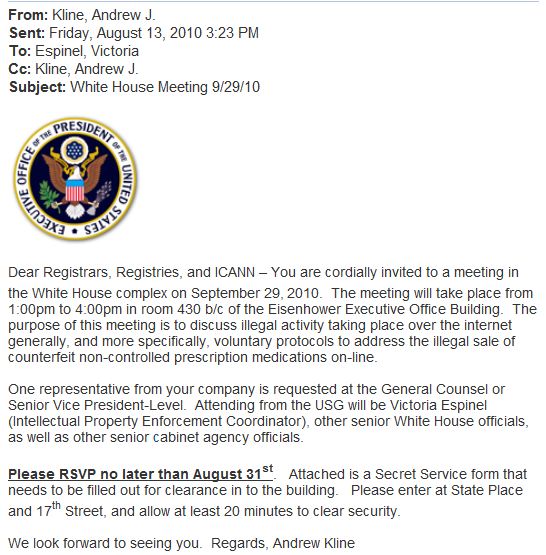
ICANN has declined an invitation from the Obama administration to attend a meeting tomorrow to discuss ways to crack down on counterfeit drugs web sites.
The meeting, first reported by Brian Krebs, was called with an August 13 invitation to “registries, registrars and ICANN” to meet at the White House to talk about “voluntary protocols to address the illegal sale of counterfeit non-controlled prescription medications on-line.”
The meeting is reportedly part of the administration’s Joint Strategic Plan to Combat Intellectual Property Theft, which was announced in June.
It also follows a series of reports from security firms that called into question domain name registrars’ willingness to block domains that are used to sell fake pharma.
ICANN tells me that, following talks with White House Intellectual Property Enforcement Coordinator Victoria Espinel, it was agreed that it would “not be appropriate” for ICANN to attend.
The decision was based on the fact that ICANN’s job is to make policy covering internet names and addresses, and not to regulate the content of web sites.
ICANN’s vice president of government affairs for the Americas, Jamie Hedlund, said the meeting was “outside the scope of our role as the technical coordinator of the Internet’s unique identifiers.”
I suspect it also would not have looked great on the global stage if ICANN appeared to be taking its policy cues directly from the US government rather than through its Governmental Advisory Committee.
Demand Media-owned registrar eNom, which has took the brunt of the recent criticism of registrars, recently signed up to a service that will help it more easily identify and terminate domains used to sell counterfeit medicines.
New TLD guidebook could be finalized in Cartagena
I’ve got the official line from ICANN — it’s possible that the final Applicant Guidebook for new top-level domain applications could be approved as early as December.
I reported late last night that, following its weekend board retreat, the final version of ICANN’s new TLD rulebook would be published before its public meeting in Cartagena, Colombia.
This morning, based on some reader comments and a closer reading of the board’s latest resolutions, I concluded that there was a pretty good chance I was wrong, so I asked ICANN for clarification.
I essentially asked whether we were looking at another six months of pondering Draft Applicant Guidebook version 5, or whether the next iteration would be the final one.
This is the official ICANN spokesperson line:
The next guidebook to be posted for public comment will be called the “next version” of the applicant guidebook – depending on public comment, the Board will decide whether to approve it as final (with changes) or request another iteration.
…
As stated above, the Board could consider approving the next version of the Guidebook as early as the Cartagena meeting or set a timeline for approval sometime thereafter.
So, there’s the answer: it depends.
Frankly, given the number and gravity of the unresolved issues on the table, I think Cartagena may be optimistic. But it’s not impossible.
(Cheers to @mneylon and @dot_scot for the constructive criticism.)
Do uncontroversial new TLDs exist?
ICANN’s Governmental Advisory Committee wants ICANN to drastically scale back the first round of new top-level domain applications, limiting it to “uncontroversial” strings.
In a letter last Thursday, interim GAC chair Heather Dryden wrote that ICANN should consider a “road test” or “fast track first round” made up of “relatively straightforward, non-sensitive and uncontroversial gTLD proposals”.
This doesn’t make much sense to me, for a few reasons.
First, Dryden’s letter does not attempt to define what such a TLD would look like, other than noting that they should include “community, cultural and geographical applications”.
Neither does it give ICANN any ideas about how it might separate out uncontroversial applications for special treatment before any applications have actually been received.
The idea might have worked had the Expressions Of Interest plan not been canned in Nairobi, but right now I can’t see an obvious way to do it without actually asking all applicants to file their apps before they have any idea of the rules their applications will be subject to or on what timeline.
It’s a recipe for, if not disaster, then for at least months and months of more delays as ICANN tries to design a parallel pre-approval process for uncontroversial strings.
Second, there’s no category of new TLD that is exclusively “uncontroversial” in nature.
The GAC wants “an initial fast track round for a limited number of non-controversial applications which should include a representative but diverse sample of community, cultural and geographical applications”.
This would seem to suggest that community, cultural and geographical TLDs are somehow less prone to controversy than other categories of application, which is not the case.
On the geoTLD front, you only need look at the large number of contested regional/city domains that we already know about – Berlin, Barcelona and Bayern, without leaving the B’s – to see that controversy is likely.
Even uncontested cityTLDs have potential for conflicts. Take .london, for example. Last time I checked, the one .london applicant we know of made it clear that .london would exclusively represent London in the UK.
If you’re a business in London, Ontario, or any other London, and nobody contests the .london bid, you’re forever excluded from the namespace. That, I would argue, could be controversial.
As for the cultural/ethnic TLDs, are the proposed .kurd, .eus (Basque) and .sic (Székely) TLDs really totally uncontroversial?
I genuinely don’t know the answer to that question, but I do know they are designed to represent peoples largely originating from (relatively recently at least, if not currently) contested territories.
And what of “community” TLDs? It’s almost impossible to argue that this category is by definition less controversial, given that essentially any applicant is eligible to designate itself a “community” TLD.
There’s a pretty decent chance that one or more .gay bids will be a community-backed application. And I strongly suspect that the GAC doesn’t like the prospect of that TLD one little bit.
Third, ICANN has already executed two limited new TLD rounds.
The whole point of the 2000 round of new TLDs was to create a “test-bed”. Similarly, a key reason the 2003 round was limited to “sponsored” TLDs was to increase the TLD pool in an orderly fashion.
The reason the GAC says wants a limited launch this time is to help ICANN in “collecting relevant information” relating to the “economic impacts of a large number of new gTLD strings”.
There’s an assumption here that the behavior of registrants, such as trademark holders, will be the same when a small number of TLDs are released as when a large number are released, or that one can extrapolate the latter from the former, which may not be the case.
If ICANN wants a limited launch in order to measure the economic impact, it has two previous such rounds to study already. But if it wants empirical data on a large number of TLDs being launched, there’s unfortunately only one way to get it.
Personally, I think the GAC’s talk of “economic analysis” and “uncontroversial strings” is more likely a smokescreen for its real concerns about nations unilaterally blocking strings they don’t like at their borders, potentially leading to root fragmentation.
Anti-terror rule dropped from new TLD guidebook
ICANN will cut references to terrorism from its Draft Applicant Guidebook for new top-level domains, after criticism from some Arab stakeholders.
The ICANN board of directors decided on Saturday at its retreat in Trondheim that it will revise its policy of doing background checks on new TLD applicants:
The background check should be clarified to provide detail and specificity in response to comment. The specific reference to terrorism will be removed (and the background check criteria will be revised).
The reference to “terrorism” first showed up in DAGv4, the latest draft. It caused a bit of a stir, with at least two Arab community members harshly criticizing ICANN for its inclusion.
Khaled Fattal of the Multilingual Internet Group told ICANN it would “be seen by millions of Muslims and Arabs as racist, prejudicial and profiling” while Abdulaziz Al-Zoman of SaudiNIC observed that’s it’s not globally accepted “who is a terrorist and who is a freedom fighter”.
It appears that their complaints have been heard.
US seeks powers to shut down domains
COICA is the new acronym we’ll all soon be talking about — it’s the law that could give the US its very own Great Firewall of China.
A bipartisan group of US senators today introduced the Combating Online Infringement and Counterfeits Act, legislation that would enable the government to quickly turn off domain names involved in piracy.
The bill would enable the Department of Justice to seek a court order against a domain name it believes is involved in piracy or selling counterfeit goods.
If the sponsoring registrar or registry is located in the US, the order would force it to stop the domain from resolving and lock it down.
The likely effect of this would be to force piracy sites out of .com and into offshore registrars. But the bill has thought about that too.
If it’s a non-US registrar and registry, injunctions could be sought to block the domain at the ISP level.
That’s right folks – if this bill passes, the US would get its very own Chinese-style national firewall.
The bill would allow the domain registrant to petition the court to lift the order.
“By cracking down on online piracy of television shows and movies, we hope this bill will encourage copyright owners to develop innovative and competitive new choices for consumers to watch video over the internet,” said Sen. Herb Kohl.
Which is about as disingenuous a statement as it gets, when you think about it, given that it essentially eliminates a major incentive for business model innovation.
Man asks ICANN for “list of all domains”
A man has used ICANN’s freedom of information procedure to ask for “a list of all registered domains”, forcing the organization to politely decline.
Barry Carter wrote (pdf):
Per http://www.icann.org/en/transparency/didp-en.htm please provide me a list of all registered domains (including all public registrant information). If you are unable to provide this information, please let me know why.
As you might imagine, with the number of registered domains in the gTLDs and ccTLDs numbering in the hundreds of millions, that’s what you might call a Big Ask.
ICANN’s response (pdf) patiently explains that it doesn’t have such a list and that assembling one would constitute an unreasonable request under its Documentary Information Disclosure Policy.
Still, worth a shot, eh?


Recent Comments