





Recent Posts
- Tomorrow is lowkey Reveal Day
- .bank registry looking for new boss
- Junk drop hits .my domains hard
- As GoDaddy loses .us to Identity Digital, some domains may be at risk
- “Time to lawyer up…” Anger grows over Verisign’s .name bloodbath
- stupid.domain.name owner fights Verisign turn-off
- Unliked — Chinese gTLD calls it quits
- .phone domain gets launch dates
- Domainer AI slop crackdown on the cards in Oz
- Team Internet still expects over $160 million for domains business
- Newfold settles Meta cybersquatting lawsuit
- DropCatch acquires 300 more registrars
- Helsinki throws in the towel on city gTLD
- “Bulletproof” registrar takes a bullet to the head
- .net prices going up
- Robles to join ICANN board
- Former ICANN director Bertrand de La Chapelle dies
- Fifty-six orgs get 85% off their gTLD fees
- Texas will object to .texas gTLD
- WordPress hints it applied for more new gTLDs
- Could you type a .chrysanthemun domain name?
- LFG boss on why Telegram gTLD fight might not be all bad news
- Harper replaces Deutsch on ICANN board
- Let’s just get this out of the way: yes there will be a .fart fight
- New gTLDs: what we do and don’t know about the 2026 round
- Government moves to nationalize .me
- Now you can plant “for sale” signs directly into your domains
- Bali to apply for .bali, and the dot is delightful
- ICANN board seat up for grabs
- As .web goes live, “.website” changes hands
- Domain name universe tops 400 million
- Team Internet sells fewer domains but makes more profit
- Ireland’s .ie formally changes hands
- Verisign’s crystal ball sees more growth for .com
- .web could be a huge payday for Verisign
- Freenom is back, but no longer free
- First dot-brand of the year self-terminates
- The Tax Man to get domain takedown powers
- Afnic: all your overseas territories are belong to us
- .ru ready to crash as Draconian new rules come in
- Google adds .here and .eat to launch roster
- “Bulletproof” registrar gets third ICANN bollocking
- Cybercrime link as t.me gets taken down
- ICANN rules could hamper agentic AI domain regs
- A dot-brand walks into a bar
- .dot is coming very soon
- GoDaddy may “exit India” over cybersquatting legal battle
- Verisign will kill off 37 Kevins (and 22,000 others), complaint claims
- Google names the dates for .fly launch
- Harassment down, bitchiness up at ICANN
- A free, ethical new gTLD? Shurely shome mishtake
- Blacknight acquired by Your.Online
- “Bulletproof” registrar gets an ICANN bollocking
- Team Internet says domains business sale imminent
- Two-letter domain auction raises half a billion (dong)
- Another country jumps on the .ai bandwagon
- ICANN lays out new rules for navel-gazing
- Surprising nobody, ICANN calls off Oman meeting
- Four registrars get terminated
- ICANN director and African internet pioneer Barrett dies
- Government to put the squeeze on .me registry partners
- More cheap new gTLD applications approved
- Nominet outsources cybersquatting disputes to WIPO
- Whois about to get even more useless
- Agentic AI has ICANN in a pickle
- .pay sunrise going gangbusters
- Nominet dodges millions in member refunds
- Identity Digital takes over 25-year-old TLD
- Ask.com hits the market as Jeeves breathes his last
- ICANN throws a bone to its most stubborn new gTLD applicant
- Cops get special Whois access rights
- Identity Digital acquires another dormant gTLD
- Verisign to delete .name 3LDs and email addresses
- Four more deadbeat registrars face firing squad
- ICANN punts on Oman meeting decision
- DNSSEC claims another registry victim
- .music has competition as .mu repositions
- Over 100 new gTLD bids have already been announced
- 2026 new gTLD round has actually opened
- Nominet wants to fight shrinkage without self-abuse
- Verisign cranks up guidance as .com swells
- More Verisign bitchiness as .com price rise revealed
- Is a .tree gTLD very cool or very silly?
- The internet just got its first new TLD since 2022
- Kid-friendly domains could be reborn
- Shrinking .us TLD is up for grabs
- Namecheap saw 116,000 phishing attacks last year
- .io safe for now as Trump puts Chagos deal on ice
- Amazon sells three gTLDs to Identity Digital
- .radio’s new owners might have a fight on their hands
- WIPO doubles the speed of UDRP cases
- Amazon joining GlobalBlock
- Unstoppable buys 10 new registrars
- ICANN cleaning house, cans four more registrars
- ICANN to throw millions more at cheapo gTLDs
- Introducing Stringtel, my new free new gTLD tool
- GlobalBlock signs the two best deals it will ever get
- Seven registrars get terminated
- GoDaddy launches DomainMaxxing to optimize your domains
- .latino gTLD to launch soon
- Amazon readies .pay gTLD
- Nominet reveals first DNS tech funding recipients
- ICANN hit with tinfoil-hat lawsuit
- .pn relaunches — you’ll never guess what they say it means
- Unstoppable focuses on proper domains, admits crypto was “craze”
- ICANN boss: no plans to scrap Oman meeting
- China domains dip in 2026
- ICANN maps out new gTLD timeline
- War disrupts ICANN 85
- Namecheap abandons fight for .org price caps
- Identity Digital acquires another gTLD
- Seven dead registrars on the out
- Sav.com owner takes over .radio gTLD
- .com zone tops 160 million domains
- ai.com, the most-expensive domain sale ever
- .ai hits seven figures, raises prices
- Typosquatter gets two years in jail
- Epstein low-balled registrants to get his exact-match domain
- Epstein bought “mother” domains for Fergie while serving time
- Two former ICANN directors want back in
- Former ICANN director could lose control of ccTLD
- UK launches “police.ai”, but does it own the domain?
- Team Internet still in talks to sell off domains unit
- NamesCon returning to Miami in November
- “Mad Dog” politician registers nazis.us, redirects to Trump admin site
Dot-brand gTLD guilty of domain name hijacking
Fashion retailer Mango, which owns its own dot-brand gTLD, has been found guilty of Reverse Domain Name Hijacking after allegedly doctoring evidence in a .uk cybersquatting case.
The company, which runs .mango, lost a Nominet Dispute Resolution Service complaint against New Zealand-based domain investor Garth Piesse over mango.co.uk and mango.uk.
It’s only the sixth RDNH finding in 13 years of DRS history.
Mango tried to buy the domain using a pseudonym and, when Piesse asked for “six figures”, filed the DRS instead.
Piesse claimed in what appears to have been a well-argued defense that the person attempting to buy the domain on Mango’s behalf did not identify Mango as the would-be buyer.
Further, he claimed that Mango deliberately tried to hide this fact from the DRS panel by scrubbing its negotiator’s email address from evidence it submitted.
While DRS panelist Tim Brown did not agree that this omission alone was enough to find RNDH, he agreed that Mango did not have “entirely clean hands”. He ruled:
The sequence of events in the present case appears to show that the Complainant attempted to buy
from the Respondent. When these negotiations failed the Complainant started proceedings under the DRS. As I have noted, the Complainant has relied on bare assertion and has provided a paucity of evidence to support its arguments.
Even a cursory reading of the Policy, Procedure and extensive guidance on Nominet’s website would quickly show that a matter concerning a clearly generic, dictionary term would require a higher standard of argument and evidence than is perhaps common. That the Complainant has failed to come anywhere close to providing sufficient argument or evidence is, in my view, strongly indicative that the Complainant pursued this dispute in frustration at the Respondent’s unwillingness to sellfor a price it was willing to pay, rather than because of the merits of its position in terms of the Policy’s requirements.
I conclude that the Complainant brought a speculative complaint in bad faith in an attempt to deprive the Respondent of the Domain Names. I therefore determine that the Complainant has engaged in Reverse Domain Name Hijacking.
Spain-based Mango has owned its trademarks for well over a decade, and Piesse only got his hands on the domains in question in 2013 and 2014.
Piesse, who owns about 18,000 domains, was able to show that Mango the brand is unheard of in New Zealand and that he has a track record of buying fruit-based .uk domain names.
Nominet to give nod to .uk privacy services
Nominet plans to start accrediting proxy/privacy services in .uk domain names, and to make it easier to opt-out of having your full contact details published in Whois.
The proposed policy changes are outlined in a consultation opened this morning.
“We’ve never recognized privacy services,” director of policy Eleanor Bradley told DI. “If you’ve registered a .uk with a privacy service, we consider the privacy service to be the registrant of that domain name.”
“We’ve been pretending almost that they didn’t exist,” she said.
Under the proposed new regime, registrars would submit a customer’s full contact details to Nominet, but Nominet would publish the privacy service’s information in the domain’s Whois output.
Nominet, getting its hands on the customer data for the first time, would therefore start treating the end customer as the true registrant of the domain.
The company says that introducing the service would require minimal work and that it does not intend to charge registrars an additional fee.
Currently, use of privacy services in .uk is pretty low — just 0.7% of its domains, up from 0.09% a year ago.
Bradley said such services are becoming increasingly popular due to some large UK registrars beginning to offer them.
One of the reasons for low penetration is that quite a lot of privacy is already baked in to the .uk Whois database.
If you’re an individual, as opposed to a “trading” business, you’re allowed to opt-out of having any personal details other than your name published in Whois.
A second proposed reform would make that opt-out available to a broader spectrum of registrants, Nominet says.
“We’ve found over the last few years that it’s quite a hard distinction to draw,” Bradley said. “We’ve had some criticisms for our overly strict application of that.”
In future, the opt-out would be available according to these criteria:
i. The registrant must be an individual; and,
ii. The domain name must not be used:
a) to transact with customers (merchant websites);
b) to collect personal data from subjects (ie data controllers as defined in the Data Protection Act);
c) to primarily advertise or promote goods, services, or facilities.
The changes would allow an individual blogger to monetize her site with advertising without being considered a “trading” entity, according to Nominet.
But a line would be drawn where an individual collected personal data on users, such as email addresses for a mailing list, Bradley said.
Nominet says in its consultation documents:
Our continued commitment to Nominet’s role as the central register of data will enable us to properly protect registrants’ rights, release contact data where necessary under the existing exemptions, and maintain public confidence in the register. It acknowledges that some registrants may desire privacy, whilst prioritising the core function of the registry in holding accurate records.
The proposals are open for comments until June 3, which means they could potentially become policy later this year.
.uk suspension problems worse than I thought
Problems validating the addresses of .uk domain registrants, which caused one registrar to dump the TLD entirely, are broader than I reported yesterday.
Cronon, which does business as Strato, announced last week that it has stopped selling .uk domain names because in more than a third of cases Nominet, the registry, is unable to validate the Whois data.
In many cases the domain is subsequently suspended, causing customer support headaches.
It now transpires that the problems are not limited to .uk second-level names, are not limited to UK registrants, and are not caused primarily by mailing address validation failures.
Michael Shohat, head of registrar services at Cronon, got in touch last night to clarify that most of its affected customers are in fact from its native Germany or from the Netherlands.
All of the affected names are .co.uk names, not .uk SLDs, he added.
And the validation is failing in the large majority of cases not due to Nominet’s inability to validate a mailing address, but rather its inability to validate the identity of the registrant.
“This is where the verification is failing. The database they are using can’t find many of our registrants’ company names,” Shohat said.
“So 30% of our registrations were being put on hold, almost all of them from [Germany] and [the Netherlands], and 90% of them because of the company name. We checked lots of them and in every single case the name of the company was correct, and the address as well,” he said.
Michele Neylon of the ICANN Registrar Stakeholders Group said that Cronon is not the only registrar to have been affected by these issues. Blacknight Solutions, the registrar Neylon runs, has been complaining about the problem since May.
According to Neylon, the Nominet policy causing the issue is its data quality policy, which covers all .uk and .co.uk (etc) names.
The policy itself is pretty vague — Nominet basically says it will work with each individual registrar to determine a baseline of what can be considered a “minimum proportion of valid data”, given the geographic makeup of the registrar’s customer base.
Domains that fail to meet these criteria have a “Data Quality Lock” imposed — essentially a suspension of the domain’s ability to resolve.
Earlier this year, Nominet did backtrack on plans to implement an automatic cancellation of the names after 30 days of non-compliance, following feedback from its registrars.
“It’s disappointing that Cronon have taken this step; we hope they will consider working with us to find a way to move forward,” a Nominet spokesperson added.
She said that the registry has over recent years moved to “more proactive enforcement” of Whois accuracy. She pointed out that Nominet takes on the “lion’s share of the work”, reducing the burden on registrars.
“However, our solution does not include non-UK data sets to cross-reference with, so it is possible that some false positives occur,” she said. “Registrars with a large non-UK registrant bases, who are not accredited channel partners, would be affected more than others.”
An Accredited Channel Partner is the top tier of the three Nominet offers to registrars. It has additional data validation requirements but additional benefits.
While .co.uk domains are not limited to UK-based registrants, all .uk SLD registrants do need to have a UK mailing address in their Whois for legal service.
The company’s inability to validate many non-UK business identities seems to mean .co.uk could also slowly become a UK-only space by the back door.
Big registrar dumps .uk — a glimpse of Christmas future?
German registrar Cronon, which retails domains under the Strato brand, has stopped carrying .uk domains due to what it says are onerous Whois validation rules.
In a blog post, company spokesperson Christina Witt said that over one third of all .uk sales the registrar has been making are failing Nominet’s registry-end validation checks, which she said are “buggy”.
With the introduction of direct second-level registration under .uk, Nominet introduced a new requirement that all new domains must have a UK address in the Whois for legal service, even if the registrant is based overseas.
According to its web site, Nominet checks registrant addresses against the Royal Mail Postcode Address file, which contains over 29 million UK addresses, and does a confidence-based match.
If attempts to match the supplied address with a UK address in this file prove fruitless, and after outreach to the registrant, Nominet suspends the domain 30 days after registration and eventually deletes it.
It’s this policy of terminating domains that has caused Strato to despair and stop accepting new .uk registrations.
“Databases of street directories or company registers are often inaccurate and out of date,” Witt wrote (translated from the original German). “The result: addresses that are not wrong, in fact, are be found to be invalid.”
Nominet is throwing back over a third of all .uk names registered via Strato, according to the blog post, creating a customer support nightmare.
Its affected registrants are also confused about the verification emails they receive from Nominet, a foreign company of which they have often never heard, Witt wrote.
I don’t know how many .uk names the registrar has under management, but it’s reasonably large in the gTLD space, with roughly 650,000 domains under management at the last count.
If Strato’s claim that Nominet is rejecting a third of valid addresses (and how Strato could know they’re valid is open to question), that’s quite a scary statistic.
Nominet seems to be using an address database, from the Royal Mail, which is about as close to definitive as it gets. And it’s only verifying addresses from a single country.
I shudder to imagine what the false negative rate would be like for a gTLD registrar compelled to validate addresses across 200-odd countries and territories.
The latest version of the ICANN Registrar Accreditation Agreement requires registrars to partially validate addresses, such as checking whether the street and postal code exist in the given city, but there’s no requirement for domains to be suspended if these checks fail.
[UPDATE: Thanks to Michele Neylon of the Registrars Stakeholder Group for the reminder that this RAA requirement hasn’t actually come into force yet, and won’t until the RrSG and ICANN come to terms on its technical and commercial feasibility.]
Where the 2013 RAA does require suspension is when the registrant fails to verify their email address (or, less commonly, phone number), which as we’ve seen over the last year leads to hundreds of thousands of names being yanked for no good reason.
If Strato’s story about .uk is correct and its experience shared by other registrars, I expect that will become and important data point the next time law enforcement or other interests push for even stricter Whois rules in the ICANN world.
Eleven domains suspended under .uk anti-rape rules
Nominet has suspended and permanently blocked 11 “rape” domain names in .uk since introducing a controversial policy earlier this year.
The company today disclosed that nine pre-existing domains were suspended immediately following the introduction of the rules in May. Another two have been blocked since then.
The policy calls for Nominet to ban any domain name that seems to “promote or incite serious sexual offences”.
Examples of such domains given by Lord MacDonald, who compiled the review that led to the policy, included rapeme.co.uk, rapemyteacher.co.uk and rapeporn.co.uk.
Nominet now automatically scans all new .uk registrations for keywords that may be a cause for concern. These are then manually reviewed to weed out the false positives, which could include for example domains that contain the word “grape” or “therapist”.
The false positive level is very high. According to a Nominet report (pdf) this week, 1,029 domains have been automatically flagged since May, only two of which were then suspended.
The policy was introduced following articles in some of the UK’s right-wing tabloids and pressure from government ministers.
Nominet also disclosed this week that 948 domains have been suspended for “criminal activity” in the last six months.
Under Nominet rules, such domains are suspended merely upon notification by the law enforcement agencies that the domain in question is suspected of harboring criminal activity. Unlike elsewhere in the world, no court order is required.
“Criminal activity” means intellectual property infringement in the vast majority of cases.
Of those 948 suspended names, 839 were suspended after complaints from the Police Intellectual Property Crime Unit. Another 102 were yanked following notices from the Medicines and Healthcare Products Regulatory Agency. The remaining 7 complaints came from the National Fraud Intelligence Bureau.
Nominet hires venture capitalist as new CEO
Nominet has named Lesley Cowley’s replacement as CEO as Russell Haworth, a Thomson Reuters alum who’s spent much of 2014 working as a venture capitalist.
Russell was previously managing director of Thomson Reuters’ Middle East & Africa division.
Since January, he’s been a co-founder and partner at Saya Ventures, an investment company focused on early-stage technology companies.
“Russell will lead the organisation as it develops its core registry business, explores the potential of new technologies, and delivers on its commitment to ensuring the internet is a force for good,” Nominet said.
He’s set to join the .uk registry in January 2015.
He replaces Cowley, who resigned in May and earlier this month revealed several new jobs.
Former pop star is .uk’s 10,000th cybersquatting case
Nominet has processed its 10,000th cybersquatting dispute, according to the company.
Conveniently for the .uk registry’s public relations department, the complainant in the case was Aston Merrygold, a well-known former member of the pop group JLS.
He won astonmerrygold.co.uk, which was registered to London-based Martyn O’Brien, using Nominet’s 12-year-old Dispute Resolution Service.
Merrygold does not have a trademark covering his name, but the DRS panelist found that he had rights anyway, due to his relative fame and numerous TV appearances.
O’Brien registered the name in 2008, along with the names of Merrygold’s band-mates, after JLS appeared in the final of TV talent show The X Factor.
JLS had a brief but successful pop career before breaking up last year. Merrygold currently intends to go solo, which presumably inspired the DRS complaint.
Nominet also announced today that Tony Willoughby, who has been chair of the DRS panel since 2002, has stepped aside and will be replaced by DRS appeals panelist Nick Gardner.
Cowley, one foot out of the industry, joins Architelos
Former Nominet CEO Lesley Cowley has become a consultant for Architelos, as part of a raft of domain and non-domain industry positions she’s taken on.
Primarily, Cowley has become chair of the UK’s Driver and Vehicle Licensing Agency — a public-sector role with a vague conceptual relationship with domain names (ie, managing lots of unique identifiers).
At Architelos, a provider of registry management software and services, she will be a “executive coach and consultant”, Cowley wrote in a blog post.
She will also remain a volunteer with ICANN, where she’s the former chair and current councilor of the ccNSO.
Cowley has also been named a non-executive director of aql, a data center in Leeds, UK.
She announced her resignation in May, after 12 years as Nominet CEO. Her replacement has not yet been named.
No mention of .london at ICANN London
The forthcoming .london gTLD didn’t get a look in during the opening ceremony of ICANN 50, held this morning in London.
The host city gTLD’s complete absence from the two-hour event — it wasn’t mentioned once — would have escaped notice had it not been for the abundance of plugs for .wales and .cymru attendees received instead.
.cymru is the Welsh name for Wales. The gTLDs are to be launched simultaneously.
Welsh First Minister Carwyn Jones was given stage time to announce, in between anti-English quips, that the Welsh government is to dump .gov.uk in favor of the two new Welsh gTLDs.
Later, a Welsh male voice choir (presumably a famous one) took to the stage to sing a couple of songs and announce that they too are planning to use .wales and .cymru for their web sites.
Nominet chair Rennie Fritchie also plugged the upcoming launches during her five-minute slot.
You’d have been forgiven for wondering if you’d accidentally got off the plane in Cardiff.
Where was .london?
Did Dot London Domains seriously drop the ball here?
Or did .london’s absence have something to do with the fact that the host ccTLD and meeting sponsor, Nominet, is the registry for .wales and .cymru but was beaten to the .london back-end contract by Minds + Machines?
.uk launches with Stephen Fry as anchor tenant
Nominet has launched its controversial .uk service, enabling Brits and others to register directly at the second level for the first time.
It did so with an endorsement from quintessential uber-Brit, gadget nut, Apple slave and national treasure Stephen Fry and a marketing splash including a .uk domain apparently visible from 35,000 feet up.
This sign has been placed in one of the main flight paths into Heathrow. Readers flying in to London for ICANN 50 later this month might want to ask for a window seat.
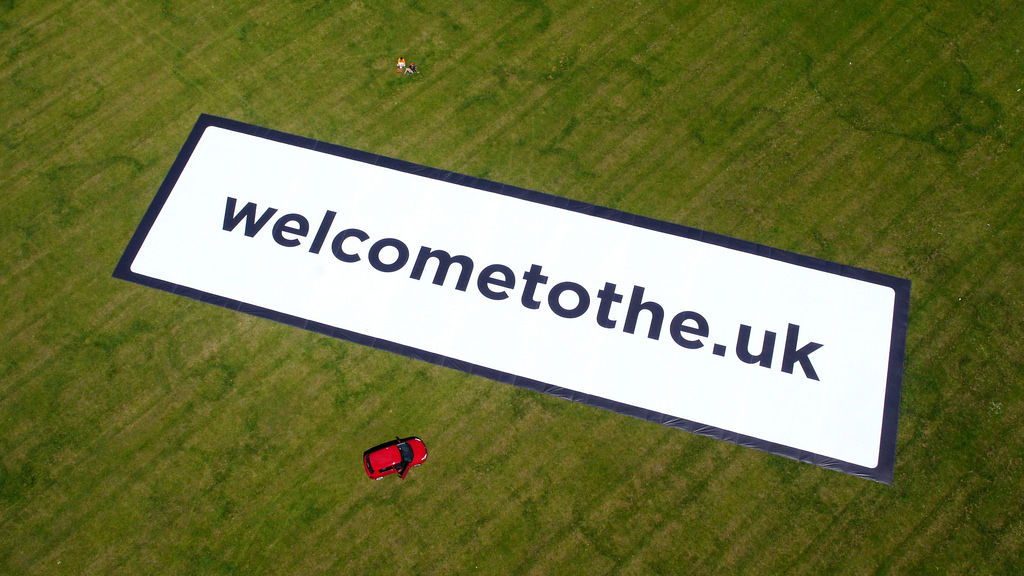
Actor/author/comedian Fry was the first to be given a .uk today. He’s switched from stephenfry.com to stephenfry.uk as a result — the .com is already redirecting to the .uk.
He said in a blog post:
It’s only three harmless key-presses, you may think. A year or so back I wrote that it seemed to me annoying and lax of the British internet authority (if such a body ever existed, which it didn’t and doesn’t) when domain names were being handed that they were so inattentive and their eyes so off the ball. How come Germany could have .de, France .fr, South Africa .za, Italy .it etc etc etc? And we poor British had to have the extra exhaustion of typing .co.uk. Three whole keystrokes. It doesn’t stack up to much when compared to other howling injustices in the world. The length of time poor students and tourists have to queue to get an Abercrombie and Fitch polo shirt for example, but nonetheless it has been a nuisance these twenty years or so.
His involvement has helped the news hit many of the major daily newspapers in the UK today.
This is how to launch a TLD.
Fry’s friend Prince Charles was given princeofwales.uk last December, among 69 domains previously under .gov.uk that the government requested receive special treatment.
While new .uk addresses are available to register now, you won’t be able to immediately register one that matches a .co.uk unless you’re the owner of that .co.uk.
All .co.uk registrants have been given five years to decide whether they want the .uk equivalent, which carries a £2.50-a-year fee ($4.20), assuming a multi-year registration.
That’s the same as a .co.uk. Assuming .uk gets good uptake and that most registrants will keep their .co.uk names for the foreseeable future, Nominet’s accounts could be in for a significant boost.
Owners of .org.uk or .me.uk names only get the free reservation if the matching .co.uk is not already registered. Otherwise, they have to wait five years like everyone else.

Recent Comments